Six questions for analyzing a website

Seth Godin brings us this gem of an article that is very useful when you want to analyse whether a website is a good investment.

It’s tempting to believe that any website can become a perpetual motion machine of profit. But before you start one, invest in one or go to work for one, a few things to ask:

  1. What’s the revenue per visit? (RPM). For every thousand visitors, how much money does the site make (in ads or sales)?
  2. What’s the cost of getting a visit? Does the site use PR or online ads or affiliate deals to get traffic? If so, what’s the yield?
  3. Is there a viral co-efficient? Existing visitors can lead to new visitors as a result of word of mouth or the network effect. How many new visitors does each existing user bring in? (Hint: it’s less than 1. If it were more than 1, then every person on the planet would be a user soon.) This number rarely stays steady. For example, at the beginning, Twitter’s co-efficient was tiny. Then it scaled to be one of the largest ever (Oprah!) and now has started to come back down to Earth.
  4. What’s the cost of a visitor? Does the site need to add customer service or servers or other expenses as it scales?
  5. Are there members/users? There’s a big difference between drive-by visits and registered users. Do these members pay a fee, show up more often, have something to lose by switching?
  6. What’s the permission base and how is it changing? The only asset that can be reliably built and measured online is still permission. Attention is scarce, and permission is the privilege to deliver anticipated, personal and relevant messages to people who want to get them. Permission is easy to measure and hard to grow.

Do the math on successful companies online and compare it to those that are struggling and these six metrics will help you understand the difference. For example, if the RPM is less than the cost of getting a new visitor, you’ve got trouble. If the site is relying on fads and occasional PR but isn’t building a permission base, that’s trouble too.

The good news is that each of them can be changed if you’re alert and willing to do surgery on the business model and structure of the site.

The ideal structure is a business that’s a platform, not merely a place to stop by. Once people move in and become members, they’re hesitant to leave, they share permission over time, they tell their friends, their RPM goes up and the cost of acquiring and hosting members goes down. The real question is: are you on that path?

Interesting in investing in websites? If you want to get into this but have no idea how to search for, value, evaluate and manage a website, give us a call. We’ll work something out.

Do You Know About This Amazing Investment Opportunity?

In this economy, where do you invest your money? What gives the best returns? We still believe that one of the best, least-known investment opportunities is investing in websites.

In fact, over the last few months, we have been quietly purchasing websites both for ourselves and some clients. Why do we think this represents a good investment? Here’s a quote from an earlier article:

A little-known way of making money online is that of investing in virtual real estate i.e. buying websites.

I know you are conversant with the idea of buying land or houses so I will use that as an example to make a point. If you buy a house at Kshs 5 million and then rent it out, the monthly rent that you can charge is usually 1% of the buying price (this sometimes varies but it is the average). Therefore, the expected rent of a house worth 5 million would be Kshs 50,000 a month or Kshs 600,000 a year. To get back your 5 million investment, it would take 8.3 years. This is considered a good investment.

A better one would be to buy a small business. The average rate of return on a small business is about 20% – i.e. if you buy a business at 5 million, you should expect to make 1 million a year. This means that it would take you 5 years to get back your investment.

What about buying a website? The strange thing is that the value of a website is usually only about 12 – 24 times its money income. That is, if a website makes Kshs 10,000/- a month, the selling price should be a maximum of 240,000/-. This means that it only takes you two years to get back your initial investment.

Sounds like a good investment to you? (Read More)

Think about that. If you spend Kshs 5,000,000 on a website you should expect to make up to Kshs 500,000 every month. And, guess what? Some types of websites require NO input from you. Can you imagine making a passive 500k every month? I don’t know what to say – I simply cannot think of a better investment in this economy! Can you?

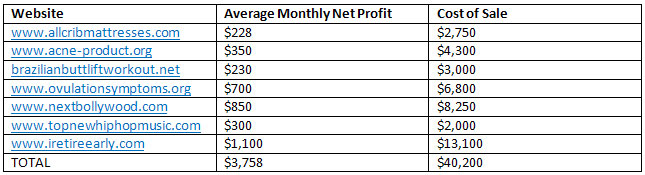
Let me share with you a snapshot of recently sold websites to further drive the point home:

Recently sold websites

Recently sold websites

From the above, the average cost of purchasing a website is about 10.7 times its expected monthly revenues.

This means that if a website makes $100 (about Kshs 10,000 currently) every month, then its expected purchase price would be $1,070 (about Kshs 100,000 currently).

A website that cost you $1,070 (about Kshs 100,000 currently) will earn $1,200 (about Kshs 120,000 currently) in one year.

Sijui if this makes any sense to you. Personally, though, at Nickel Pro we have been aggressively investing in websites to the point where now a significant part of our revenues is on “autopilot” (it comes whether we work or not). Hakuna pesa tamu kama hiyo, let me tell you! :)

So, as you are thinking of where to invest your money. Spare a thought for websites. In my opinion it is one of the best investments out there. If you want to get into this but have no idea how to search for, value, evaluate and manage a website, give us a call. We’ll work something out.

Cheers!

An Opportunity to Make Money as a Developer in Kenya

I’m writing this blog post cuddled up in a tent in Naivasha’s Crayfish Camp while attending the 2011 Kenya WordCamp.

WordCamp Kenya is a conference about the world’s most popular blogging software WordPress. Developers, designers and users will come together for talks and workshops related to WordPress and to publishing on the web, and to network.

WordPress, of course, is the rockstar of online web publishing. It is so good that it is used to power 14.7% of the top one million world’s biggest websites. In the USA, WordPress has been used to create and manage 22% of all new websites in the year 2011. It is used in 8% of the websites on the entire web. Clearly, WordPress is the one of the biggest and most widely used CMS.

I’m here primarily because I am one of the speakers at this conference. I had an interesting presentation on DukaPress yesterday. If you are not attending this event, well, pole kwako.

I would say the majority of the people who made it are bloggers from Kenya – very prominent Kenyan bloggers. It has been wonderful meeting some of the people I look up to. It is very good to see that Kenya has a very strong and thriving blogosphere.

However, I am disappointed in that I found that the number of WordPress developers here is relatively small. In fact, my observation is that in Kenya, generally, WordPress developers are few and far between. For example at DukaPress last year we wanted to hire a number of WordPress developers but could not find more than one or two who actually had experience with WordPress from all those who applied for the jobs.

I feel that this represents a massive opportunity for developers in Kenya. WordPress is HUGE. In fact, on almost all of the “freelancer” websites (like freelancer.com, guru.com, elance.com etc) the vast majority of all programming/web development jobs are related to WordPress. If as a developer you know how to work well with WordPress, you can easily make money online, offline or both. Just look at what our small team has been able to do with DukaPress.

Think about it. Can you take advantage of this opportunity?

PS: You can get more information on WordCamp Kenya here. You can follow the event live on Twitter by following @WordCampKE or #WCKE which is the official hashtag.

Your Cannot Afford To Miss WordCamp Kenya 2011

What is WordPress? WordPress is a content management system (CMS). In simpler terms, WordPress is software that is used to create websites and manage them. Such software makes both the creation and management of a website simpler and better.

WordPress, in particular, is so good that it is used to power 14.7% of the top one million world’s biggest websites. In the USA, WordPress has been used to create and manage 22% of all new websites in the year 2011. Clearly, WordPress is the one of the biggest and most widely used CMS. (Source of statistics).

Are you using WordPress for your own website? Why not? If the very very biggest websites use it, it means it is world-class, right? Well, you can use the same world-class software for free right now: www.wordpress.org

Our own DukaPress is an e-commerce engine for WordPress. i.e. we enable you to quickly and easily create an online shop using WordPress and DukaPress.

This year, Kenya will host East Africa’s first WordCamp: WordCamp Kenya 2011. This will be an informal conference about WordPress. It is your golden opportunity to learn why WordPress is used to power nearly one-fifth of all the websites in the world.

It is your opportunity to meet bloggers, developers and businesses who thrive on WordPress.

Come and learn about blogging, online content publishing and how to make money from your WordPress blog/site or from WordPress itself.

Whatever you do, do not miss this.

More info: WordCamp Kenya 2011

Lethargy in The Kenyan Newspaper Industry

Let’s start with the words of Donnacha who wrote the following in a discussion of the choice of Newspapers’ publishing software on the Internet:

This is why local newspapers are dying, not because technology was inevitably going to wipe them out but because journalists are so used to superficially skimming the details and coming to trite conclusions rather than bothering to actually understand things – decades of poor journalism echoed in bad business decisions.

The Internet isn’t killing newspapers, it could have been a huge boon to them, they are committing suicide.

Obviously, I don’t have access to the backend of The Concord Monitor but, seriously, I could whip up something more stylish, easier to maintain and with a better publishing work-flow in one day by simply building upon a good Genesis theme, Justin Tadlock’s Members plugin, Gravity Forms, Yoast’s SEO and a few other old reliables. I have seen the “professional” tools that cost crazy amounts and they are way behind the best of WordPress.

The problem, and I come across this all the time, is that companies have experienced such horrific abuse from their previous CMSes that they simply can’t believe this stuff can actually be easy and, of course, there’s usually some lazy IT guy in the background, worried that his cover will be blown, persuading them that they need to pay fifty grand for a “professional solution” – this is why the “WordPress is for blogging” meme refuses to die, because a lot of people are making a living from it. When clients are clueless – and print journalists tend to be surprisingly technophobic – such manipulation becomes standard practise, it’s an industry-wide Stockholm Syndrome.

Unfortuantely, this makes me immediately think of Kenya’s very own Financial Post.

Proudly broken - www.financialpost.co.ke

Proudly broken - www.financialpost.co.ke

The Financial Post’s website, in my humble opinion is woeful. It is broken. It is a shame. Sadly, for as long as I can remember they have had that same exact website up. If the Financial post has any “IT” staff, one wonders why they exist. I also know for a fact that the Financial Post has received quite a number of proposals for their website’s improvement (including one from me years ago).

Why would any sensible organisation keep their website in such a state? To make matters worse, The Financial Post is a news organisation. They can earn significant amounts if only they had a stable, working website. Add to this the fact that there is no other major Kenyan news site offering the same kind of ‘financial news’ and you are left to wonder why they let this opportunity go.

In other countries, it is said that the newspaper and print industries may die. Perhaps it is not so in our Kenya. But is this really an excuse to sit back and do nothing? The Internet is relatively small in Kenya, but it is getting bigger. Soon enough, our own ‘print industry’ will be in real trouble. Is that the time when organisations like the “Financial Post” wake up?

I am sure that The Financial Post is just one of the many lethargic organisations in our newspaper industry. Apart from the big names – Daily Nation, Standard, etc – the rest are not doing anything significant online, are they? Donnacha’s words above come to mind, “The Internet isn’t killing newspapers, it could have been a huge boon to them, they are committing suicide“.

PS. The absolutely saddest thing is that any good web developer can turn www.financialpost.co.ke into a classy, beautiful website that earns money in about a week!!

R.I.P. Steve Jobs

Join us on a journey through the ups and downs of a career that has changed both the tech industry and our culture at large.

YouTube Preview Image

Words of wisdom from Steve Jobs:

Remembering that I’ll be dead soon is the most important tool I’ve ever encountered to help me make the big choices in life. Because almost everything – all external expectations, all pride, all fear of embarrassment or failure – these things just fall away in the face of death, leaving only what is truly important. Remembering that you are going to die is the best way I know to avoid the trap of thinking you have something to lose. You are already naked. There is no reason not to follow your heart.

Your time is limited, so don’t waste it living someone else’s life. Don’t be trapped by dogma – which is living with the results of other people’s thinking. Don’t let the noise of others’ opinions drown out your own inner voice.

Your work is going to fill a large part of your life, and the only way to be truly satisfied is to do what you believe is great work. And the only way to do great work is to love what you do. If you haven’t found it yet, keep looking. Don’t settle. As with all matters of the heart, you’ll know when you find it. And, like any great relationship, it just gets better and better as the years roll on. So keep looking until you find it. Don’t settle.

Thank you Steve, for making a dent in the universe.

The Power of ‘Organic’

One of the most important business concepts is captured by the word “organic”. I actually use this word quite a bit in conversations and in talks and it’s not really because I’m into organic food.

No, when I use the word “organic” I’m talking about what happens when you get any slice of real nature in all its richness, in any sphere of life.”Vitamin C” is a substance called ascorbic acid, something you can make in the lab. You want pure vitamins? No problem, somebody can always sell you some, it’s 100% pure from textbook chemistry.

But everybody knows you can’t live on laboratory vitamins. Plus we all know deep down that vitamins + junk food = self deception. But… if you eat a spinach salad, you get something entirely different. Whether you know what’s in it or not, you know it’s good for you. Why? Because it’s real. You don’t have to go to a health food store to get that; you don’t even need to know what vitamins are. All you have to do is eat real food.

The business version of this might be… Let’s say you’re thinking about investing in a company, or even getting a job there – which would provide you with more information about how healthy they are?

A) Reading all the press releases in their website
B) Sitting in their lunch room for 30 minutes, just listening to the conversations around you

Fact is (B) is probably the better way to go. You’d quickly develop a sense of the morale, the spirit of the company that a piece of ‘official’ communication deliberately attempts to hide.

Malcolm Gladwell refers to this in his book “Blink”, where he discusses our remarkable human ability to make snap judgments based on quickly sizing up this sort of organic information. He calls the process of forming accurate first impressions “thin slicing.” “Blink” is a great read and makes many valuable points. John Fox and I talk about this organic cultural factor in our interview.

I’ve defined marketing as ‘helping people who need each other find each other’ and that is best accomplished by clearly and effectively communicating who you are.Which of course requires that you know who you are in the first place.

If you know that and communicate it effectively, you attract not just the right customers, but the right employees, vendors, partners and investors. The consistency and believability of your message is contagious.

The whole of this article is based on an email received from Perry Marshal