Archive for the ‘Internet Culture’ category

Taxi Driver In India Uses Youtube to Find Customers

March 12th, 2010

So, I read this over at Alootechie and felt that I had to share it with you, dear readers.

Apparently, Divesh Mishra, an Indian taxi driver was worried that his business was going down. This was in January 2008 when the Indian travel industry was experiencing a downturn. Divesh knew he had to do something to keep his business going.

“I wanted to advertise about my services but could not do that as I did not have much funds,” Mishra said. “This was the time when I met a friend from Singapore. He was one of my customers and I discussed my problems with him. He then suggested me to upload a video on YouTube. Though I knew about internet, I had never heard about YouTube before.” (Source)

The rest, as they say, is history. Divesh’s video has been viewed 24,000+ times and he reportedly gets hundreds of emails a week – from foreigners asking about his services for when they visit India. According to Mishra it was amazing to get such response and this made him understand the power of internet. “It was a wise decision as I eventually understood that I could not have reached those consumers if I had advertised on some other media. Internet helped me to reach out to foreign customers,” he said.

Embracing the internet changes lives, and businesses. What about you, though? What are you doing to tap onto the opportunities provided by the internet?

A New Day Has Come

February 14th, 2010

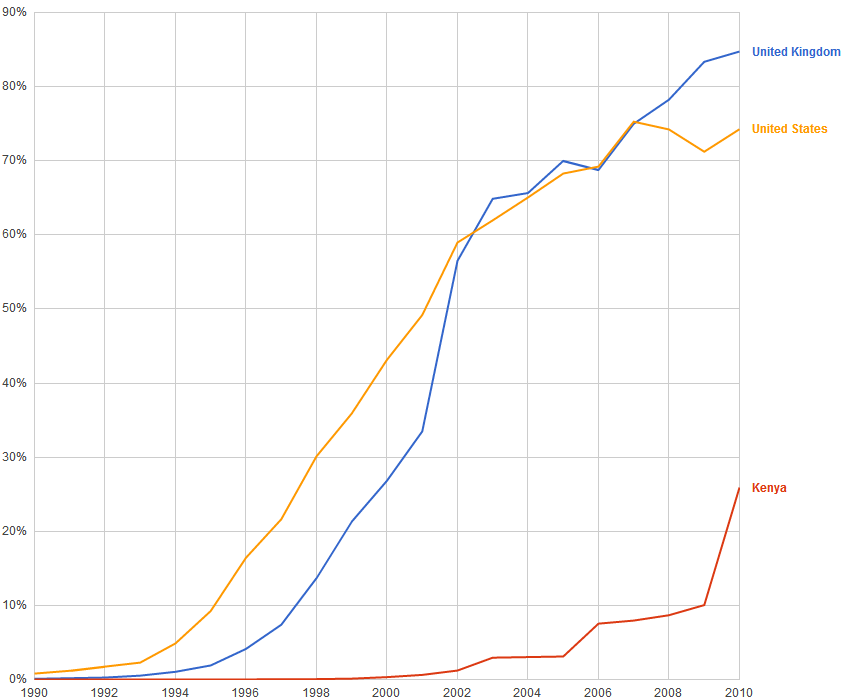
I’ve just read an article in the Business Daily in which they mention some research findings of a research by Synovate Kenya (formerly Steadman). The article is titled, “Facebook now clicks trouble for TV, radio”.

According to the article (courtesy of Moses Kemibaro):

  • Kenya now has over 2 million registered users on Facebook.
  • Email is being discarded in favour of social networks like Facebook and Twitter by new Internet users in Kenya. One quarter of Kenyans who are online do not have email addresses.
  • 79% of Kenya’s Internet users are members of Facebook.
  • Daily and weekly Internet usage in Kenya have both doubled in the last two years whereas monthly usage grew by over 80% in the same period.
  • Kenyan Internet users spend approximately 70 minutes online during each visit. This utilization is comparable to the average amount of time spent on television.

Moses Kemibaro provides further analysis of the research findings here.

What does this mean for you and I? Internet usage in Kenya is growing at an astonishing rate. This, coupled with the arrival of fibre last year, means that, alas, the time has finally come for Kenyan businesses everywhere to to view and treat the Internet with great care – lest they fall by the wayside. When the Internet was taking root in the more developed countries, a lot of businesses chose to ignore it. Those businesses failed, or lost significant market share. Do not let this be you.

Moreover, if you ever had any thoughts of using the Internet to enhance your business or if you ever wanted to start an online business, then the time to act is now. Lots and lots of people are embracing the Internet, you must be one of the first movers in order to succeed early and establish yourself as a force.

How To Monitor Your Brand Online For Free

February 5th, 2010

Monitoring what people say about your business online is very important. Everyone and anyone can talk about your business on their blogs, twitter or facebook. However, the very nature of the internet means that what people say about you online can reach millions of people in a few weeks, a few days, or even a few minutes! What if a disgruntled customer talks ill of you and suddenly millions of people hate your business? You need to monitor what people say about you so that you can understand how people view your business and respond to what people say. This is called online reputation management (ORM).

A common challenge for businesses seeking to do ORM is that the internet is too large and it would not be feasible to effectively monitor everything at an unacceptable cost. Well, that used to be true. Today, though, you can monitor your brand very effectively, for free. Watch the video below to learn more.

YouTube Preview Image

The strategy is based around using online tools to generate real-time feeds which you can monitor from one central location, Google reader. (You can use any other feed reader).

If you need help or any clarifications feel free to leave a comment below. Good luck.

Websites Influence 97% of Online Purchase Decisions

January 20th, 2010

“Your website may very well be the most powerful tool in your marketing kit. Not only is it the place prospects and clients go to learn more about you and your services, but it has a huge impact on their ultimate purchase decision. In fact, only 3% of the 200 buyers surveyed – from companies of all sizes – say a provider’s website has no influence whatsoever over their purchase decision.

The survey was conducted by RainToday.com and included more than 200 buyers responsible for more than $1.7 billion in professional services purchased, such as accounting and financial consulting; architecture, engineering, and construction services; human resources consulting; IT consulting and services; legal services; management consulting; marketing, advertising, and public relations; and training services.” – HubSpot

So, yeah, even as you are working on Facebook, Twitter, or anything else to market your business online, do note that the most important tool in your arsenal is your website. Spend more time and money on it than on anything else!

Hi Tech Porn

January 12th, 2010

Some people say that for several decades now, the adult entertainment industry has driven the world’s mass adoption of some of the technologies that we now take for granted, the video cassette in the 1980s, satellite television in the 1990s, VCDs, DVDs and the present day Internet.

Is this really true? It may be – for example, hundreds of scientists have been looking to make a personal robot for decades and now we have a ’sex robot’. Read more.

What do you think of a wolrd in which high tech is driven by porn?

Social Media Explained

November 17th, 2009

Interview by KTN’s Larry Madowo with Mark Kaigwa and Kahenya Kamunyu. Watch and share :)

You Need To Know About Online Reputation Management

October 13th, 2009

Guess what? Everyone’s a critic these days. Of course this has always been true but, these days, every one of these critics can probably go online and write their thoughts on facebook, twitter or even their own blog. Why should you care?

Suppose you own a nice little restaurant and one day, I have lunch there. I don’t like the food and/or service and so immediately after (or even during) lunch I write on my facebook “I hate Restaurant X, the food smells”. Suddenly all of my facebook friends know that you serve smelly food at your place. They’ll maybe tell their friends who will then tell their friends, and the whole thing could grow into quite a movement against your restaurant. And you probably don’t even sell smelly food.

Before the internet, it was very difficult for a single person to spread news to large groups of people but now one can do it in five minutes. As the internet grows in importance in our lives here in Kenya, business owners should be wary of the dangers that it brings. It could take just one blog post or status update to cost you hundreds of potential customers. This is why online reputation management is important.

Online reputation management is the deliberate act of making sure that what people find when they look for you or your business online is favorable to you. Wikipedia defines it as, “the practice of consistent research and analysis of one’s personal or professional, business or industry reputation as represented by the content across all types of online media.”

When you Google your name or that of your business. Do you like what you find on the first page of results? When you Google my name, the first page of Google displays articles that I’ve written, and links to other places that I hang out online. This is by no means an accident, I consistently try to influence what others find when they look for me. What about you, or your business?

Many companies in Kenya may get a big surprise at what people are saying about them online. For example, at Like Chapaa we’ve talked about quite a number of Kenyan companies but only a handful have even noticed that we talked about them. What else are they missing?

Kenya’s N-Soko Vs Craigslist

September 5th, 2009

N-SokoSo this week saw the arrival of Craiglist to Kenya. I’ve waited for Craiglist to come home for years and now it’s finally here. For those who aren’t familiar with Craigslist, it is one of my all time favorite websites. Craigslist is basically an online classifieds site. Its claim to fame is that its (mostly) free model has largely destroyed the paid classifieds market in the US and elsewhere. It is also run very admirably. Can you imagine one of the biggest web brands with a total employee count of <20 (last time I checked)?

Paul Graham, in How to Start a Startup, mentions Craigslist in an interesting way, “I advised startups never to let anyone fly under them, meaning never to let any other company offer a cheaper, easier solution. Another way to fly low is to give users more power. Let users do what they want. If you don’t and a competitor does, you’re in trouble…. The ultimate way to be nice to users is to give them something for free that competitors charge for. During the 90s a lot of people probably thought we’d have some working system for micropayments by now. In fact things have gone in the other direction. The most successful sites are the ones that figure out new ways to give stuff away for free. Craigslist has largely destroyed the classified ad sites of the 90s…

So, the mighty Craigslist landed in town…just when the local giant, the mighty Nation Media Group, was launching its own online classifieds service, N-Soko. Now, I did not get a chance to have a look at N-Soko (because it was pulled down – shame!!) but Moses Kemibaro had a look and writes, “N-Soko, …even though it has the backing of East Africa’s largest media business, is on the backfoot. Whilst N-Soko is a great initiative in terms of creating a local online classifieds brand, the whole execution of the web site is lacking. It feels disjointed from the homepage as you open up separate browser windows for each category of classifieds. It quite simply does not feel as simple, user-friendly or as well put together as the spartan looking Kenya CraigsList.”

Now, currently, the N-Soko site shows “Site Under construction”. From Moses Kemibaro’s post, it is fair to assume that the N-Soko site had been up when he had a look at it. So, what happened that it was suddenly pulled down and slapped an “under construction” sign? And, Moses mentioned that some ads were already live on the N-Soko site. Pray, what happened to those? I don’t know, readers, this is just not good. I’m all for local creativity and enterprise but you got to do it right.

In my mind, NMG just put something together and launched it in the tried and tested Kenyan style of “good enough”, ugh. And it would have worked too – N-Soko would be heavily pushed by the NMG and would be successful, no doubt. But Craiglist came along. I’d bet that part (or all) of the reason that the NMG site is now “under construction” is the entry of Craigslist into the equation. This marks the first contact in what I hope will be a hot battle of two great sites. The wars for online Kenya are just getting started. :D

We’re living in interesting internet times.

500 Million Dollars, Gold Farming, And A Death Cry

August 29th, 2009

Nearly 500,000 people in developing nations earn a wage making virtual goods in online games to sell to players, a study has found.

Research by Manchester University shows that the practice, known as gold-farming, is growing rapidly….Professor Richard Heeks, head of the development informatics group at Manchester who wrote the report, said gold farming had become a significant economic sector in many developing nations.

“I initially became aware of gold farming through my own games-playing but assumed it was just a cottage industry,” said Professor Richard Heeks from the University of Manchester who wrote the report.

“In a way that is still true. It’s just that instead of a few dozen cottages, there turn out to be tens of thousands.” Prof Heeks said very accurate figures for the size of the gold farming sector were hard to come by but his work suggested that in 2008 it employs 400,000 people who earn an average of $145 (£77) per month creating a global market worth about $500m. But, he said, the true size of the sector was hard to estimate – it could easily be twice as big. – BBC NEWS.

I used to run a video games’ arcade near Pangani in Nairobi – the business was good and the experience quickly made me realise that kids in Kenya nowadays are very much into games. We don’t have a shortage of people who can play games in Kenya. But many of these people who can play games are on the street and unemployed. Why isn’t gold farming working here in Kenya? I think that it can be a significant source of income for young people.

The following video is an in-depth look at the realities of gold farming in China:

YouTube Preview Image

Most MMO players hate gold farmers and it is not hard to find “All gold farmers must die” videos on youtube. Mostly, though you get them as all “Chinese” gold farmers must die. I think this is sad, and wrong. People have to realise that different people play for different reasons – some for fun, and some for a living.

When you get people with more money than time and others with more time than money the two will find a way to meet. What do you think?

Don’t Let This Be You – How Twitter Was Violated

July 20th, 2009

Twitter is probably the world’s hottest technology company in the world at this time. If you follow the world technology industry, you’ll no doubt see Twitter in the news at least once a week, every week. Well, this past week, Twitter was in the news again – for all the wrong reasons. A cracker from France (named “Hacker Croll”) managed to single-handedly break down Twitter’s security system and gain access to confidential company information, employee records, calendars, phone logs, credit card numbers and other information.

In a thriller of an article, Techcrunch lays bare the riveting story of how Hacker Croll violated Twitter. Here is a summary of how he did it:

1. HC accessed Gmail for a Twitter employee by using the password recovery feature that sends a reset link to a secondary email. In this case the secondary email was an expired Hotmail account, he simply registered it, clicked the link and reset the password. Gmail was then owned.
2. HC then read emails to guess what the original Gmail password was successfully and reset the password so the Twitter employee would not notice the account had changed.
3. HC then used the same password to access the employee’s Twitter email on Google Apps for your domain, getting access to a gold mine of sensitive company information from emails and, particularly, email attachments.
4. HC then used this information along with additional password guesses and resets to take control of other Twitter employee personal and work emails.
5. HC then used the same username/password combinations and password reset features to access AT&T, MobileMe, Amazon and iTunes, among other services. A security hole in iTunes gave HC access to full credit card information in clear text. HC now also had control of Twitter’s domain names at GoDaddy.
6. Even at this point, Twitter had absolutely no idea they had been compromised.

Read about the whole thrilling account here.

In computer security circles, they say that a computer system can never be 100% secure – there’s always a hole somewhere that can be exploited by someone who is determined to do so. However, most organisations and individuals (probably even you) are very very poor when it comes to security in the computer systems (especially online) that they use.

As seen in the Twitter cracking, a single Gmail account fell and this opened the door for the whole company to be compromised. Could this happen to you? No, really, could it? Rethink your approach to computer security, reset those passwords and do not use a single password for all the services and systems that you use. Change your passwords regularly and do not use passwords that can be easily guessed.

Always be on your guard. Otherwise, You may come to regret it.